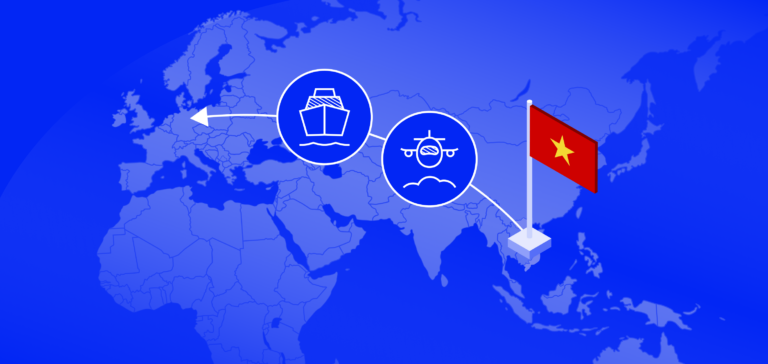

Vietnam-EU bilateral trade exceeded €70 billion in 2025, making Europe one of Vietnam’s largest trading partners.
Growth across the corridor has been driven by Vietnam’s expanding manufacturing base, rising foreign investment, and the EU-Vietnam Free Trade Agreement (EVFTA), which continues to strengthen trade flows between both markets.
Vietnam now plays a central role across sectors including electronics, machinery, consumer goods, textiles, and industrial manufacturing. The country has also become a key hub for European importers looking to diversify production and reduce dependence on single-country supply chains.
As manufacturing activity and supplier networks expand across different regions of Vietnam, logistics execution is becoming more demanding.
In this article, we examine how logistics networks between Vietnam and Europe are evolving, the operational challenges shaping the corridor, and what companies should consider when choosing a freight-forwarding partner.
Vietnam’s evolving logistics landscape
Vietnam’s export growth is closely linked to long-term shifts in global sourcing strategy. As manufacturers diversify production across Asia, the country has become a central hub within “China+1” and multi-origin supply-chain models.
In 2025, Vietnam’s manufacturing sector grew by almost 10% year-on-year, reflecting continued growth across industrial production and export activity. Electronics, semiconductors, and high-tech goods now account for a growing share of Vietnam-Europe trade, while rising foreign investment continues to expand supplier networks and manufacturing capacity across the country.
Logistics operations across Vietnam are highly regionalized. Manufacturing clusters, ports, airports, and inland infrastructure vary significantly between the north, south, and central parts of the country.
The result is a logistics landscape shaped by regional routing differences, uneven infrastructure capabilities, and growing multimodal transport requirements.
Key export corridors and transport networks in Vietnam
Vietnam’s export activity is concentrated across three major regional corridors, each with different manufacturing strengths, transport infrastructure, and freight requirements.
The country’s logistics network is anchored by two major port clusters: the northern gateway around Hai Phong and Lach Huyen, and the southern hub centered on Ho Chi Minh City and Cai Mep-Thi Vai.
Inland transport corridors and international airports support both regional Asian trade and Europe-bound freight flows, while key air cargo gateways including Noi Bai and Tan Son Nhat handle long-haul export traffic into major European hubs.
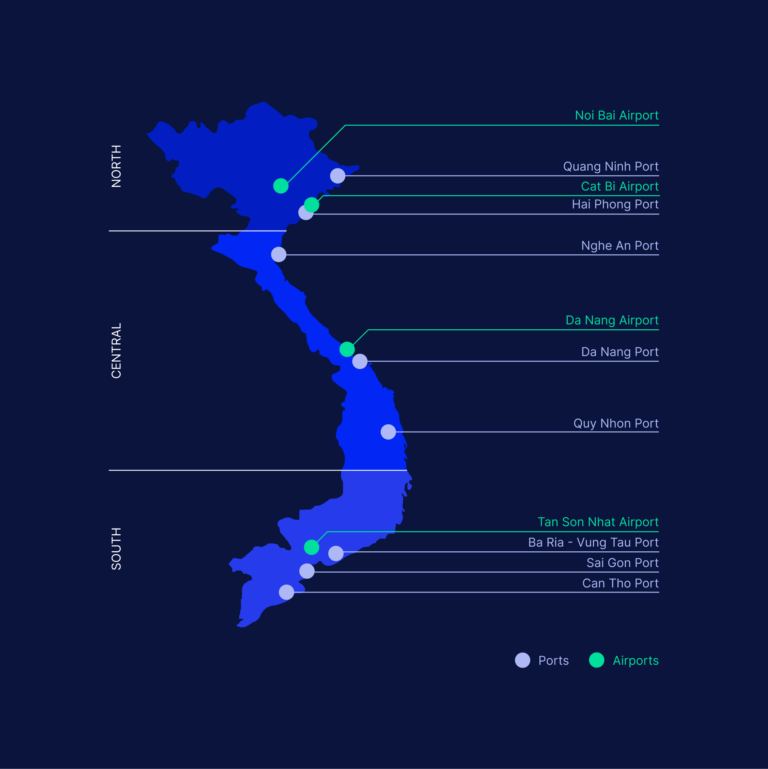
The North: High-tech manufacturing and industrial supply chains
Northern Vietnam has become a major centre for electronics, semiconductors, machinery, and industrial manufacturing, particularly around Hanoi, Hai Phong, Bac Ninh, and neighbouring industrial provinces.
The region benefits from strong highway connectivity and close integration with China-linked supply chains, while Hai Phong and Lach Huyen serve as key maritime gateways for exports to Europe.
Time-sensitive electronics and semiconductors also rely heavily on air freight, with many routings passing through regional transfer hubs due to limited direct long-haul capacity.
The Central and Southern regions: Direct export flows and multimodal connectivity
Central Vietnam primarily functions as a coastal transit and export corridor, supporting agriculture, mining, regional manufacturing, and the export of wooden furniture (including garden furniture) through coastal ports and east-west trade routes.
In the south, Ho Chi Minh City and the Cai Mep-Thi Vai deep-water port cluster dominate export activity across sectors including textiles, furniture, ecommerce, consumer goods, and industrial manufacturing.
Cai Mep’s direct long-haul services to Europe support large-scale ocean freight movements from southern Vietnam. At the same time, the wider southern region relies heavily on inland trucking, feeder services, and multimodal coordination between industrial parks, ports, and airports.
The challenges of scaling supply chains across Vietnam
Vietnam’s export growth also exposes the operational challenges of managing supply chains across multiple production regions and transport networks.
Production, warehousing, and cargo movements are often spread across suppliers, industrial zones, and inland transport corridors, creating additional planning pressure before freight even leaves the country.
Infrastructure pressure and freight volatility
These operational pressures are further intensified by infrastructure constraints, congestion, and wider freight-market volatility across Vietnam’s transport networks.
Logistics costs remain high at roughly 16–17% of GDP, while domestic freight still depends heavily on road transport. This increases exposure to inland delays, fuel-price fluctuations, and transport disruption across key manufacturing and export corridors.
Customs procedures and documentation requirements can also vary between ports and border points, creating additional demands for teams managing shipment schedules and maintaining reliable lead-times.
Global freight volatility adds further complexity. Air freight transit times, for example, can differ significantly depending on carrier capacity, routing structures, and the availability of direct long-haul connections into Europe.
Severe weather events, flooding, and typhoons continue to disrupt regional transport networks, while geopolitical instability is placing additional pressure on transit times, rerouting decisions, and freight rates between Asia and Europe.
The value of operational coordination
Managing Vietnam-Europe logistics increasingly requires close coordination across suppliers, carriers, and transport networks.
Local teams on the ground can help respond to schedule changes earlier, maintain communication between stakeholders, and oversee multimodal handovers throughout the export process.
For companies operating across multiple production regions and transport modes, strong freight-forwarding support, established carrier relationships, and direct operational visibility will improve planning accuracy and response times across the corridor.
Managing Vietnam-Europe logistics operations
Supply chains between Vietnam and Europe require close operational coordination, and freight forwarders now need to support far more than cargo movement alone.
Planning reliability, shipment visibility, and proactive communication have become essential operational capabilities.
For importers managing distributed production and volatile freight markets, an onsite freight-forwarding team with local knowledge and established networks is central to maintaining reliable operations.
Forto’s operations in Vietnam
The Forto Vietnam team officially received its operating license and opened our Ho Chi Minh City office in 2021.
Collaborating with logistics partners, our team supports shipment planning, supplier coordination, documentation management, and multimodal transport execution across Vietnam-Europe operations.
Shipment preparation and export handling
- Working directly with suppliers to verify cargo readiness and reduce delays before shipments leave Vietnam.
- Documentation handling and export coordination managed locally, improving planning reliability across different origin points and transport modes.
- Coordinating multimodal handovers between trucking, air, and ocean freight providers at origin to help maintain shipment continuity across Vietnam-Europe operations.
Proactive handling and issue escalation
Schedule changes, capacity constraints, and routing disruptions can quickly affect shipment planning across Vietnam-Europe operations.
Our local team responds to operational issues early, helping prevent delays from escalating further.
Having teams on the ground also allows for faster escalation and more direct communication than relying solely on external agents, particularly when shipments require rapid adjustments or multimodal coordination.
Supplier relationships and local networks
Developing and maintaining long-term relationships with suppliers and local transport providers cannot be underestimated.
The Forto team working directly with local partners is often able to identify delays, documentation issues, or capacity constraints earlier in the process, allowing proactive adjustments to be made.
These relationships also help strengthen communication across regions and transport modes, particularly when schedules shift or disruptions occur.
Multimodal flexibility and routing adaptability
No single transport strategy fits every shipment. Across the Vietnam-Europe corridor, transit times, freight costs, and carrier availability can all shift quickly depending on routing structures, capacity availability, and wider freight-market pressures.
Maintaining flexibility is therefore essential for companies looking to protect lead times and budgets.
Choosing the right transport strategy
Transport planning often depends on operational trade-offs. Companies need to balance shipment priorities, lead-times, and costs against delivery expectations.
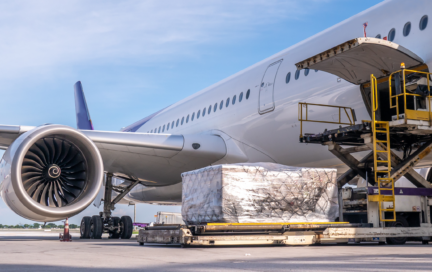
Air freight can significantly reduce transit times for critical shipments. However, direct long-haul services and lower-cost indirect routings can involve very different lead-times and cost structures depending on transfer hubs and carrier schedules.
Ocean freight, meanwhile, offers greater cost stability for less time-sensitive shipments when longer planning cycles are possible.
We help companies evaluate these routing options through our operational visibility, regional expertise, and a clear understanding of available network structures.
Adapting transport operations
Shipment plans across the Vietnam-Europe corridor often need to be adjusted due to congestion, capacity shortages, schedule changes, or geopolitical disruption.
Keeping shipments moving often depends on making smaller routing or scheduling adjustments rather than major changes to transport plans.
Cargo may need to be rerouted through alternative hubs, shifted between feeder services, or moved onto indirect carrier routings to avoid bottlenecks and maintain delivery schedules.
Forto’s teams in Vietnam and Europe coordinate directly with suppliers and logistics partners on the ground to assess alternative routings and implement operational changes when transport plans need to shift.
Multimodal flexibility across regional networks
Vietnam-Europe shipment flows frequently move through domestic trucking networks to Vietnamese ports and airports, connecting either directly to Europe-bound long-haul routes or moving via feeder services to regional export hubs.
Managing these transitions efficiently becomes particularly important when transport plans need to be adjusted after the cargo is already in transit.
Examples of common Vietnam-Europe routing approaches include:
| Transport approach | Example routing | Operational advantage | Typical shipment profile |
| Direct air freight | Vietnam → Europe direct long-haul | Fastest transit windows with fewer transfer points | Time-sensitive cargo |
| Indirect air routing | Vietnam → regional transit hub → Europe | Lower-cost airfreight with longer but more flexible transit windows | Cost-sensitive air shipments |
| Direct ocean freight | Vietnamese port → direct ocean vessel → Europe | Fast ocean transit times by bypassing regional transfer hubs | High-volume cargo needing efficient lead-times |
| Ocean freight with feeder connections | Inland trucking → Vietnamese port → feeder service to regional hub → main ocean vessel → Europe | Greater carrier optionality for less time-sensitive freight | High-volume cargo with longer planning cycles |
| Regional multimodal routing | Vietnam → truck transfer → regional export hub → Europe | Helps maintain shipment continuity when direct capacity or schedules become constrained | Shipments requiring tactical rerouting |
Forto supports these transport flows through dedicated lane development, including a Hamburg corridor, as well as carrier coverage across both direct mega-vessel services and feeder-based connections.
Shipment visibility and coordination
Shipment coordination continues long after cargo leaves the supplier. Routing updates, milestone tracking, documentation handling, and communication between stakeholders remain ongoing throughout the transport process.
Shipment visibility
Through our digital platform, Ship by Forto, logistics teams can track shipments, manage transport documentation, and receive milestone updates from booking through to delivery. Automated notifications help teams respond more quickly to schedule changes and routing updates.
Stakeholder communication
Our platform also enables fast communication between internal stakeholders, suppliers, and dedicated Forto operations managers.
Managing complexity across the Vietnam-Europe corridor
Shipping between Vietnam and Europe now involves far more than selecting a transport mode or booking cargo capacity.
Routing variability, fragmented supplier networks, and shifting transport requirements all place greater pressure on planning accuracy, shipment visibility, and communication throughout the transport process.
Managing these challenges successfully requires local expertise, flexible transport options, and centralized coordination across suppliers, carriers, and internal stakeholders.
With teams on the ground in Vietnam and integrated multimodal capabilities, Forto helps companies maintain more reliable and responsive operations across the Vietnam-Europe corridor.
Learn more about Forto’s Vietnam-Europe transport solutions across sea, rail, and air freight.