
A container sits a few days too long at the terminal, and suddenly there’s a demurrage invoice you didn’t budget for. For logistics teams, these charges are one of the most common sources of unplanned freight costs.
Port congestion can hit at any time. Whether driven by global shipping reroutings, unpredictable vessel arrivals, or hinterland bottlenecks like seasonal low water levels, terminal capacity at major ports can quickly become strained. When ports back up, containers dwell longer and the risk of demurrage and detention (DEM/DET) charges climbs.
For most teams, the problem comes down to clarity and control. Shorter free-time allowances and complex carrier terms make it hard to know when charges start, while a lack of real-time visibility means a container can quietly pass its last free day before your team has a chance to act.
This article breaks down how DEM/DET charges work, steps to verify and dispute incorrect fees, and strategies to help protect your shipping budget.
Demurrage and detention explained
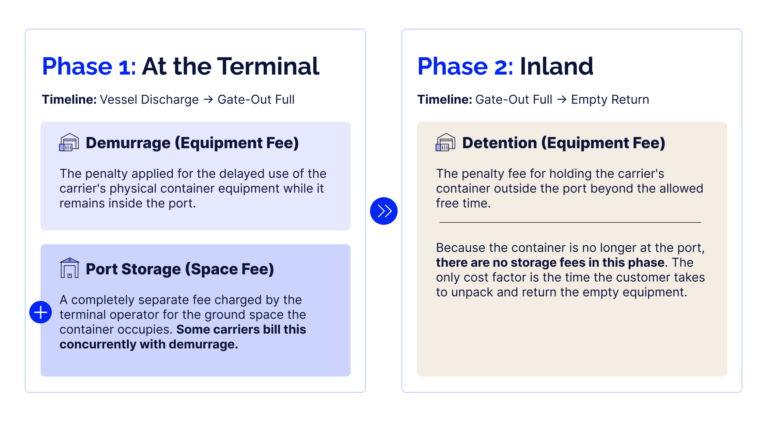
To manage DEM / DET costs effectively, it helps to start with clear definitions. While demurrage, detention, and storage are sometimes grouped together on freight documents, they apply to different locations and assets:
| Charge type | Where it happpens | What it covers | Who charges it |
| Demurrage | Inside the port or terminal | Loaded container using port equipment and space past allowed free time | Ocean carrier |
| Detention | Outside the port or terminal | Container equipment held past allowed free time for loading, unloading, or drayage | Ocean carrier |
| Storage | Inside the port or terminal | Physical ground space occupied at the terminal facility | Terminal operator |
Overview of charges:
Gaining clarity on your demurrage and detention costs
Understanding how free time is structured in your carrier agreements helps prevent unexpected fees. Carrier agreements vary, but your costs will primarily depend on three key variables. Understanding these will help you verify your invoices down the line and flag any errors.
Key factors that shape your costs
1. Combined versus separate tariffs
- Separate free time: You receive dedicated days for demurrage (such as 5 days inside the terminal) and a separate allowance for detention (such as 5 days outside the terminal). Unused demurrage days cannot be transferred to cover detention.
- Combined free time: You receive a single block of days (such as 10 total days) covering the container from vessel discharge until the empty container returns to the designated depot. While this setup offers more flexibility, transport providers do not routinely offer combined free time.
2. Trigger events for free time
Check your contract to confirm when the free time countdown begins. Some carriers start counting at vessel discharge, while others start when the container is physically available for gate pickup. Fees shouldn’t be charged if the container isn’t available yet or if the gates are closed.
3. Tiered daily rates
Demurrage and detention rates usually increase after the initial free period ends. For example, days 1 to 3 past free time might incur a standard daily rate, while day 4 onwards incurs a higher daily rate. Small delays can quickly increase total costs if daily rates step up.
How to verify your invoices
Industry benchmarks show that 15% to 20% of demurrage and detention invoices contain errors. Common examples include fees charged on days when terminal gates were closed or charges starting before container availability was officially confirmed.
Here’s how to protect your invoices:
- Keep timestamp logs: Maintain operational records of gate-in dates, gate-out dates, and official container availability notices.
- Clarify terms upfront: Ask your logistics provider to confirm whether your tariff is combined or separate, and verify the exact start trigger for free time. Also check whether storage is charged separately. This changes from port to port.
- Negotiate terms directly: Request appropriate free time during contract discussions based on typical dwell times at major ports like Rotterdam, Antwerp, or Hamburg.
- Share details with finance: Provide contract terms and rate cards to your accounting team so they can review invoices before processing payments.
Gaining control over your demurrage and detention costs
Managing demurrage and detention fees can feel challenging when terminal delays, gate closures, or port congestion are out of your control. While external disruptions cannot be avoided, your team’s response can make a significant difference to your bottom line.
Taking a structured operational approach helps keep container movement on schedule and costs predictable.
Rather than addressing delays after fees have already accrued, a proactive strategy focuses on clear visibility, close drayage coordination, and standardized internal processes. This turns day-to-day fee management into a clear, repeatable workflow.
Four practical tactics to reduce fee risks
Tactic 1: Pre-arrival readiness
Submit customs declarations and documentation before the vessel arrives. Clearing paperwork early ensures inland hauliers can pick up containers as soon as they are discharged.
Tactic 2: Last free day tracking
Track the last free day (LFD) for each container rather than relying only on vessel arrival estimates. Prioritizing pickups by last free day ensures containers move before fees apply.
Tactic 3: Clear agreements with drayage partners
Work with your drayage partners to establish clear pickup schedules that prioritize containers approaching their free time limits.
Tactic 4: Container reuse
Where carrier rules allow, coordinate street turns to transfer an empty import container directly to an exporter without returning it to the port terminal first.
How Ship by Forto helps you stay in control
Managing free time tracking across multiple shipments can be time-consuming. Ship by Forto simplifies container tracking and invoice verification through clear digital workflows:
- Pre-arrival updates:
For shipments without Forto on-carriage, automated notifications send updated free time details 7 days before estimated vessel arrival. - Arrival notifications:
Receive clear updates on free time calculations as soon as the vessel arrives in port. - Automated alerts:
Get notifications when free time limits are exceeded for demurrage, detention, or combined tariffs, giving you complete visibility over costs. - Simple invoice review:
If you identify an error on an invoice, Ship by Forto provides a direct claims process within the platform. You can upload documentation, submit claims, and check resolution progress in one central place.
Keeping your shipping clear and predictable
Managing demurrage and detention fees does not have to be complicated. With clear contract terms, organized tracking, and digital tools, you can protect your margins and keep your ocean freight running smoothly.
Tired of auditing unexpected demurrage and detention invoices?
Discover how Forto gives you real-time last free day alerts and automated tracking of your shipments. Get in touch to schedule a first call with our team and they will walk you through it.