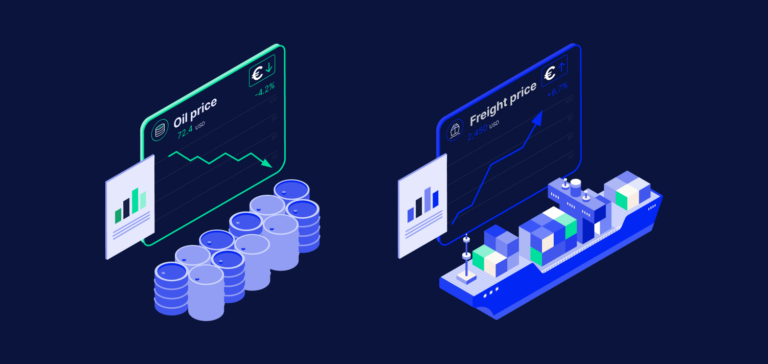

As a shipper, you might ask yourself this reasonable question: if oil prices are falling, why are container shipping rates going up? If fuel is one of the biggest costs in moving a ship, shouldn’t cheaper oil mean cheaper freight?
Over the past weeks, fuel costs have come well off their highs from earlier this year as tensions in the Persian Gulf have eased. At the same time, container spot rates have moved the other way, climbing steeply.
It’s a fair question, and one we’re hearing frequently from supply chain managers and logistics professionals. On the surface, this might look unexpected, but it is actually normal market mechanics.
In this article, we will break some myths and explain:
- Why oil prices and shipping rates move independently
- What actually drives container shipping rates
- 2026 oil & shipping cost developments as an example
- What this means for you as a shipper
Let’s dive in.
Why do oil prices and shipping rates move independently?
Short answer: They are driven by entirely different market forces and operate on completely different timelines.
While oil prices react almost instantly to global energy shifts and geopolitical events, carriers adapt their fuel surcharges much more slowly. Shipping lines typically use a moving average of the previous quarter’s fuel costs to calculate their bunker surcharges – often called BAF, or Bunker Adjustment Factor. This creates a built-in time lag. When oil prices spike, shippers don’t feel it immediately; conversely, when fuel prices plummet, those savings only trickle down into surcharges weeks or months later.
But more importantly, fuel is just one piece of the puzzle. While it represents a baseline operating cost, it does not directly dictate the spot market. Container shipping rates are ultimately driven by vessel capacity and consumer demand – forces that can move completely independently of the oil market.
In the next section, we’ll dive into what actually drives container shipping rates.
What actually drives container shipping rates?
To understand freight pricing, we have to look at the two engines of the market: capacity and demand.
A container spot rate – the price to move a box right now, tracked by indices like the SCFI (Shanghai Containerized Freight Index) – is mainly driven by how much vessel space carriers have on the water versus how much cargo actually wants to move.
When space is tight relative to demand, index-level rates go up.
Space constraint generally happens when:
- Vessels take longer routes to bypass regional disruptions, which extends transit times and delays empty container returns.
- Carriers cancel sailings (blank sailings) to artificially manage capacity.
- Cargo volumes surge all at once because shippers are rushing to pull orders forward.
Fuel matters to a carrier’s bottom line, of course. But it is only one operational input among many, and it does not dictate the spot rate directly.
2026 oil & shipping cost developments as an example
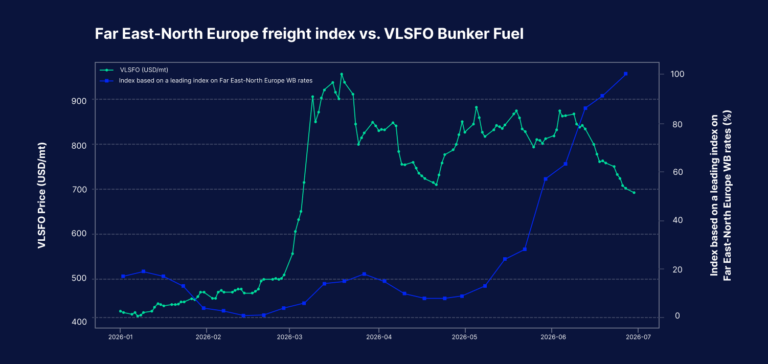
This year’s developments in the Persian Gulf are a perfect example of this disconnect. In February 2026, geopolitical disruptions around the Strait of Hormuz sent shockwaves through the energy market, causing oil prices to spike instantly. While index-level shipping rates did see a slight upward trend at the time, the impact was not comparable by any means (see image 1).
Currently, the Strait of Hormuz is in a cautious, partial restart, and while some market analysts project a subsequent easing of global crude prices, ocean freight costs have followed a completely different trajectory – with container spot rates rising sharply since late May.
This reality proves a fundamental logistics truth: crude prices can normalize in a day, but global supply chains can take much longer to untangle.
Months of severe disruption have left a massive backlog of ships; so even as temporary transit corridors slowly open back up, container networks are still wrestling with extended reroutings, scrambled schedules, and severe port congestion. Ultimately, this physical scarcity of vessel space keeps container rates propped up regardless of crude oil developments.
What this means for you as a shipper
The takeaway is simple: Do not read falling oil headlines as a sign that your shipping costs are about to drop.
If you want to anticipate where your freight costs are heading, ignore the oil market. Instead, keep a close watch on the true market signals (shipping capacity and cargo demand) and aim for a transparent relationship with your freight forwarder.
This is one piece of a bigger picture and we want to help you navigate what comes next. Join our upcoming Market Update webinar, where we will go beyond the headlines to break down exactly what these developments mean for your upcoming shipments and supply chain strategy.