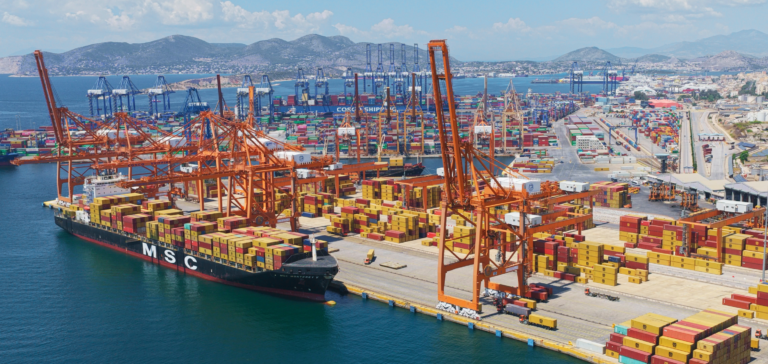
Berlin, October 14th, 2026 – In the third quarter of 2026, ocean freight rates on the Far East–North Europe trade lane eased from an early-July peak, falling by approximately 32% by late September. The decline was limited by severe port congestion in Asia, which is absorbing a significant share of available capacity.
At the same time, ocean carriers resumed select services via the Suez Canal, although the Cape of Good Hope remains the standard routing.
In contrast, air freight demand remained robust, shifting significantly toward the technology sector: Growth was primarily driven by semiconductors, AI hardware, servers, and data center infrastructure, while e-commerce lost momentum. These are the findings of a recent market analysis by the technology-driven freight forwarder Forto.
Economic Outlook: Energy Costs Remain a Drag
The Eurozone economy developed more resiliently than expected, with GDP growing by 0.6% in the second quarter compared to the previous quarter. However, inflationary pressures remained high. Inflation accelerated to 3.8% in September, while the ECB raised its deposit facility rate to 2.50%. High energy prices added further pressure, with Brent crude oil temporarily climbing above USD 108 per barrel in September.
Ocean Freight: Rates Soften Following Early Peak Phase
On the Far East–North Europe route, the SCFI sub-index evaluated by Forto reached its quarterly peak of USD 3,418 per TEU in early July. It subsequently declined week after week, standing at USD 2,313 by the end of September—around 32% below its peak. Nevertheless, the quarterly average of USD 2,889 per TEU remained 36% above Q2 and 72% above the prior-year level. The higher Q3 average is attributable to differing starting baselines: In the second quarter, rates only began rising sharply from late May onward, whereas the third quarter started from an already elevated level.
The rate decline is smaller than in previous years because extreme port congestion in Asia is absorbing a substantial share of vessel capacity. Some analysts estimate that around 3 million TEU, or roughly 8.5% of global capacity, is currently tied up in delays, compared with 13.8% at the height of the pandemic. Carriers have also begun routing individual services back via the Red Sea. Around one third of planned Asia-Europe services are currently scheduled via Suez, the vast majority on the backhaul, where just over half of services are planned through the canal. On the headhaul, only about one in five services into North Europe and a little over one third into the Mediterranean are affected. These first returns therefore bring little relief where congestion weighs most heavily.
“Many are currently focusing on the Suez route, but the operational bottleneck is located at the ports. We haven’t seen port congestion this severe since Covid,” says Jessy Brughmans, VP Global Trade at Forto. “As a rule of thumb, one week of severe port congestion can cause up to a month of downstream delays. Shippers should therefore build realistic buffers into their planning rather than betting on a quick return to normal.”
More Suez Reroutings, Persistent Port Bottlenecks
While carriers are gradually increasing their use of the Suez route, the standard routing on Asia-Europe Westbound remains around the Cape of Good Hope. Bottlenecks simultaneously intensified at ports: Typhoons caused severe backlogs in China, while high terminal utilization, labor disputes, and low water levels strained operations in Northern Europe. During the June/July two-month period, schedule reliability on the Asia–North Europe trade lane stood at 65.0%. However, performance varied widely between carrier alliances: Gemini achieved a schedule reliability of 99.2%, whereas Premier Alliance reached only 39.2%.
Air Freight: Tech Demand Remains a Key Growth Driver
The third quarter in air freight closed on a stronger note than the summer months suggested: in September, global cargo volumes rose 6% year-on-year, while capacity expanded by 2%. The global spot rate climbed to an average of USD 3.10 per kilogram—up 2% month-on-month and 27% higher than the previous year.
Since July, the removal of the EU customs exemption for low-value shipments under EUR 150 has also been impacting the market. According to Forto, this is dampening e-commerce volumes, particularly on the China–Europe trade lane, freeing up capacity for traditional general cargo. In the medium term, however, e-commerce providers are expected to adapt their supply chains to the new regulatory landscape.
Rates picked up again in September, particularly on Asia outbound routes. On China–Europe, the spot rate rose 10% compared to August, reaching USD 4.26 per kilogram. The trend observed in Q2 continued: semiconductors, AI hardware, servers, and data center infrastructure remained key growth drivers.
Consequently, capacity on select Asian lanes was tight at times. In the fashion sector, Forto also continued to observe modal shifts of time-critical shipments from ocean to air freight.
“More capacity across the market as a whole does not automatically mean space is available on the relevant routes at the right time,” says Christopher Braun, VP Global Operations at Forto. “For Black Friday shipments from Asia, we therefore recommend departing no later than calendar week 46 and factoring in an additional 48 to 72 hours for customs clearance, handling, and final delivery.”
Outlook: Ocean Freight Softens, Air Freight Gains Selective Traction
Forto does not expect a blanket decline in ocean freight rates for the fourth quarter. While rates experienced a seasonal drop around China’s Golden Week holiday, severe port congestion in Asia is limiting downward pressure. Looking ahead to Chinese New Year, rates could firm up again later in the quarter. Furthermore, ocean carriers have already announced blank sailings, enabling them to withdraw capacity from the market.
In air freight, Forto anticipates localized spikes in demand toward the end of the year. Peak season volume driven by Black Friday and Christmas could temporarily squeeze capacity, especially on China–Europe and other tech-heavy trade lanes. However, Forto does not expect a broad-based demand boom: growth impulses are likely to come from specific sectors rather than general consumer spending. At the same time, high fuel costs should prevent rates from dropping significantly on more competitive routes.
About the Market Analysis
The Forto Market Analysis is based on internal and external market data as well as operational insights. The evaluation incorporates freight rates, capacity trends, schedule reliability, demand developments, and macroeconomic conditions.
About Forto
Forto is a leading technology-driven freight forwarder headquartered in Berlin. The logistics company delivers end-to-end solutions for global supply chains, empowering business customers to manage international shipments with transparency, efficiency, and sustainability—from booking and tracking to advanced analytics.
Through FortoLabs, the company also operates a platform for AI-powered SaaS solutions in logistics. Originally developed for Forto’s proprietary operations, these technologies are now available as standalone products to other industry players.
Founded in 2016, Forto today operates globally across its own international offices and a trusted global partner network.
For more information: www.forto.com | www.fortolabs.com
Forto Press Contact
Renate Härle
Director of Marketing, Forto
[email protected]
STROOMER COMMUNICATIONS
Christian Stephan
Senior PR Consultant
[email protected]