
This blog article was published on Feb 24. Given the latest developments in the Middle East, some things may have evolved.
Details and the latest updates are available on our Middle East situation update page: https://forto.com/en/middle-east-situation/
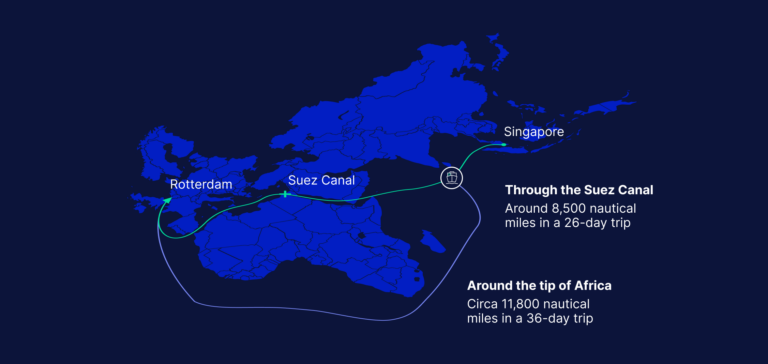
After nearly two years of disruption in the Red Sea, shipping lines are beginning to cautiously test a return to the Suez Canal on selected services.
Since December, a small number of carriers have conducted trial transits or reinstated limited routes through the Suez. However, these moves do not yet amount to a broad return to pre-crisis East–West routing and most Asia–Europe container traffic continues to sail via the Cape of Good Hope.
While the change is a meaningful step and reflects the more stable security conditions in the region, the overall situation remains cautious and is being closely monitored.
Timings: How a return is likely to unfold
A broader shift will not happen overnight. From an operational perspective, any switch back to the Suez Canal requires advance planning around insurance coverage, vessel scheduling, berth windows, and equipment positioning.
The return is expected to follow an incremental service-by-service approach, which could include:
- Changes communicated weeks, not days, in advance
- Carriers starting with individual services, assessing risk, and gradually expanding routings
In reality, this means planning teams should expect a period of mixed routings and inconsistent lead times as services adjust at different speeds.
“A return to Suez routing is not a 48-hour decision. From an operational standpoint, carriers need weeks of preparation, and any shift is likely to happen service by service with advance notice.”
Stefan Hartmann
Head of Trade Asia Europe, Forto
Likely operational impacts during a return to Suez routing
Industry analysis points to two effects of a Suez return: short-term disruption at destination ports, followed by a structural release of vessel capacity into the market.
Disruption risk at European ports
As services shift from the Cape of Good Hope route back to shorter Suez transits, vessels that were previously spaced further apart may arrive within much shorter time windows, leading to:
- Overlapping arrivals on the same services
- Pressure on berth windows and terminal yard capacity
- Knock-on delays to inland transport
Scenario modelling by Sea-Intelligence indicates that the speed of any return is critical. A rapid, uncoordinated shift back to Suez could temporarily push European terminal volumes to around 30–40% above previous peak levels.
A more phased return (circa 6 weeks) would still result in volumes roughly 10% above historical highs during the adjustment period, before vessel schedules and port rotations re-stabilize.
Capacity release and freight rate volatility
Routing via the Cape of Good Hope absorbs vessel capacity through longer voyage times. As services shorten via Suez, that capacity is gradually released back into the global container market.
Estimates indicate that a return to Suez routing could release up to 2.1 million TEU of effective capacity (circa 6% of the current global fleet).
This increase in available capacity is a key factor shaping freight rate behavior. In the short term, rate movements are likely to be volatile, driven by:
- Inconsistent service reliability
- Congestion-related surcharges and delays
- Equipment imbalances as networks resynchronize
However, over time, increased available capacity is likely to place downward pressure on freight rates, even if volatility persists during the adjustment phase.
How should logistics teams prepare?
A transition back to Suez routing may involve short-term operational challenges, including delays due to port congestion, higher handling and storage costs at the destination, increased risk of demurrage and detention, and, in some cases, additional insurance-related charges.
To minimize these risks and associated costs, logistics teams should plan for a shifting, fluid environment. The focus should be on visibility, flexibility, and clear, proactive communication while carrier routing decisions continue to evolve.
In practice, this means:
- Plan for mixed Suez and Cape of Good Hope routings, with variable lead times
Avoid relying on single transit-time assumptions while services adjust unevenly. - Prioritize carrier service updates over news headlines
Carrier schedule updates and rotation changes will matter more than general market news. - Build flexibility into inbound planning and commitments
Particularly for shipments moving through congested European ports.
- Focus on total landed cost, not just ocean rates
Including potential demurrage & detention, port handling, and inland delays during the adjustment period. - Ensure access to timely, shipment-specific information
Early visibility can help planning teams react before disruption escalates.
During such periods of network adjustment, clear communication and reliable operational support can make all the difference in managing disruption and avoiding downstream surprises.
How is Forto supporting logistics teams?
During this period, Forto is closely monitoring developments at carrier level and across individual services. Our teams are staying close to carrier communications, schedule changes, and operational signals across trade lanes.
This allows us to provide early visibility into potential routing shifts, lead-time changes, and congestion risks as they emerge. It’s underpinned by Forto’s digital infrastructure, reliable carrier data, and broad logistics partner network.
Where conditions are changing, Forto delivers timely, transparent updates on what is happening, what may change next, and how this could affect delivery timelines or costs.
Crucially, these signals are combined with hands-on operational support. Forto’s sea freight experts provide practical and shipment-specific information, helping logistics teams assess options, manage risk, and make informed decisions.
Throughout this period, our priority remains the same: to reduce uncertainty, maintain transparency, and support teams with dependable operations and accountable human expertise.
Frequently asked questions
As conditions in the Red Sea continue to evolve, Forto remains focused on providing clarity and operational confidence. If you have questions about what this means for your shipments or planning, the Forto team is ready to support.