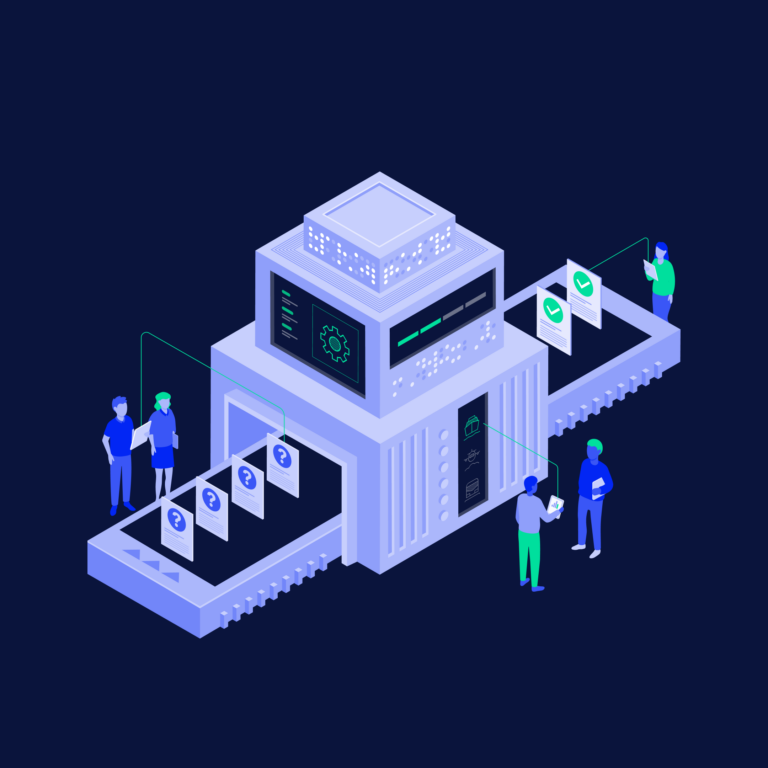

Artificial Intelligence offers immense potential for the logistics industry. Characterized by its complexity and lack of standardization, the sector has historically struggled with technological advancements like digitization and automation. However, AI possesses the unique capability to operate effectively in chaotic environments, being able to analyze big amounts of unstructured data.
Despite the potential, a significant gap exists between AI’s capabilities and its practical implementation. Forto’s Trend Compass survey, which gathered insights from 271 logistics professionals, reveals that nearly 40% identify AI as the most impactful future trend. Yet, only 11.9% report widespread adoption within their organizations.
In this article, we will explore how you can effectively leverage AI in your logistics processes and how you can indirectly benefit from it by looking out for the right service providers.
Do you want to get more insights from the Forto Trend Compass 2025?
Download the full report for free on our website and learn more about how AI is expected to shape the future of logistics.
The benefits of integrating AI technology in supply chain processes
When implemented strategically, Artificial Intelligence can deliver great benefits to logistics operations. It can automate routine and complex tasks, enabling operations managers to focus more on strategic initiatives and unlock entirely new operational capabilities.
Let’s take a closer look at two of the advantages.
Enhanced data reliability
Advanced AI systems offer superior tracking capabilities, more accurate predictions, and clearer visibility across the entire supply chain.
Practical applications: Machine learning algorithms can analyze extensive datasets from IoT sensors on shipments and vehicles to provide highly accurate estimated times of arrival (ETAs) in real-time. AI can also detect anomalies in supply chain data, identifying potential issues like misplaced inventory or fraudulent activities, which leads to improved planning and reduced uncertainty.
Greater operational efficiency
Automated processes result in faster quote generation, quicker booking confirmations, and more responsive customer service. AI can also optimize complex logistical challenges that are beyond human capacity.
Practical applications: AI facilitates dynamic route optimization, adjusting routes in real-time based on traffic, weather, and delivery priorities. Automated load planning systems use AI to maximize container space and reduce shipping costs for different transport modes (e.g. sea freight or air freight). Your logistics operations become more agile and efficient, often without the need for significant internal AI investment.
Why AI adoption remains challenging
Despite these compelling benefits, AI adoption in logistics processes faces several significant barriers. Understanding these obstacles is a crucial first step in developing effective implementation strategies.
The Forto Trend Compass survey highlighted the most important current barriers:
Cost concerns
Implementation and maintenance expenses are a primary concern, with 41.3% of respondents citing cost as their main barrier. Implementing AI technology often requires substantial upfront investment in AI infrastructure, software licensing, and ongoing system maintenance. Additionally, attracting and retaining specialized talent contributes to high personnel costs.
Security and privacy worries
Data protection remains a major concern, with 36.2% of professionals expressing worries about privacy and security. Given the sensitive nature of supply chain data – including customer information, pricing details, and operational metrics – these concerns are well-founded and necessitate robust security frameworks and compliance with data protection regulations.
The skills gap
Perhaps most critically, 35.4% of respondents identify a lack of technical expertise and resources as a major hurdle. This skills gap encompasses both the technical knowledge required to implement AI solutions and the operational understanding needed to maximize their effectiveness. Developers with extensive experience in AI technologies are scarce and highly sought after, making recruitment challenging.
Control and reliability issues
Concerns about loss of control affect 33.6% of respondents, while worries about unreliable output impact another segment of the industry. These concerns stem from the “black box” nature of some AI models, where decisions are not easily interpretable, and the potential for errors if AI systems are not adequately trained or maintained. Addressing these requires maintaining human oversight and ensuring AI systems provide consistent, trustworthy, and explainable results, especially in an industry as complex and high-stakes as logistics.
Strategic partnership: A smart path forward
The challenges of implementing AI internally are significant. For many companies, building in-house AI capabilities demands substantial investments in specialized personnel and expertise. If internal blockers prevent you from implementing AI yourself, a clear path forward is to carefully select service providers that are already integrating AI into their processes.
This approach allows you to leverage the power of AI without the steep upfront costs and risks of internal development. By partnering with providers who are leaders in AI adoption, you can immediately benefit from their established expertise and operational efficiencies. Such partners are equipped to deliver superior service quality, faster response times, and proven solutions, directly enhancing your own business’s efficiency and competitiveness.
Forto: An industry innovator enhancing service quality with AI
Forto stands as a digital freight forwarder that has, from its very beginning, leveraged technology to improve logistics processes, being the first freight forwarder to offer a digital platform to its customers.
Our commitment to innovation is deeply ingrained in how we operate, especially in how we serve our customers.
This year, Forto introduced Flash by Forto, the industry’s first Transport Management Agent. This multi-agent AI system currently handles 50% of Forto’s export booking requests with over 90% decision accuracy. Flash is designed to automate tedious manual tasks for the operations team, which frees up their time. This allows the team to focus more deeply on complex customer inquiries and deliver rapid, high-quality support on urgent matters.
For our customers, this means faster, more precise responses, fewer delays, and a consistently smoother service experience, elevating the overall quality of your logistics customer service.
Making the right choice for your business: Build versus partner
The decision to “build or not to build” in-house AI capabilities is a significant one, and the answer hinges on your business’s unique setup, available resources, and strategic goals.
When to partner:
For companies with limited technical resources, those seeking immediate AI benefits, or aiming to mitigate risk, working with AI-enabled logistics service providers offers compelling advantages:
- Immediate access: You gain immediate access to AI benefits without lengthy development timelines.
- Risk mitigation: You avoid the substantial costs and uncertainties associated with internal AI development, effectively mitigating related risks.
- Proven solutions: You benefit from tested, production-ready AI systems that have already demonstrated their effectiveness.
- Ongoing innovation: Your service provider is responsible for staying up-to-date with the latest AI developments and integrating them into their services, so you don’t have to.
When to build:
While partnering offers many advantages, building in-house AI capabilities might be the optimal choice in specific scenarios:
- Core competitive advantage: If AI is central to your unique competitive differentiation and requires deep integration with highly proprietary systems.
- Unique data and specialized problems: When your business possesses highly specialized data sets or faces unique logistical problems that off-the-shelf solutions cannot adequately address.
- Full control and intellectual property: If your strategy demands complete control over the AI’s development, intellectual property, and its long-term evolutionary path.
Strong existing tech capabilities: If your organization already has a robust in-house tech team, significant data science expertise, and a culture of innovation.
What’s next for your business?
The choice of how to integrate AI into your logistics processes – whether through internal development or by partnering with AI-powered providers – is a strategic one. But one thing is very clear: you need to start looking at AI right away. This technology is going to change logistics in a big way, and if you don’t use it, you might fall behind.
If you want to make use of AI-powered logistics services to make your supply chain more efficient and your customers happier, think about partnering with Forto. We use AI to power our freight services. This means your business gets great efficiency, more reliability, and a much smoother experience – ultimately ensuring your goods reach your customers in time. We’re helping to build the future of moving goods, and we invite you to be a part of it.
Ready to see how an AI-powered freight forwarder can help your business? We would love to talk to you!