
When the success of your business depends on getting your goods from A to B as quickly, efficiently and reliably as possible, choosing the right freight forwarder is critical.
A freight forwarder is the specialist intermediary between your business and logistics carriers, coordinating everything from booking cargo space and negotiating rates to preparing documentation and consolidating shipments.
As global trade grows more complex, having an expert logistics partner is vital. Whether it’s weather disruptions, port congestion, strikes, or geopolitical tensions, a skilled forwarder will manage these challenges, keeping you informed and your cargo moving.
But which one should you choose? What should you look for, and just as importantly, what should you watch out for?
In this article, we examine market segmentation, compare the main forwarder types, and guide you through the decision-making process with a clear, step-by-step approach and expert tips.
Let’s dive into the world of freight forwarding.
Freight forwarding market in 2025
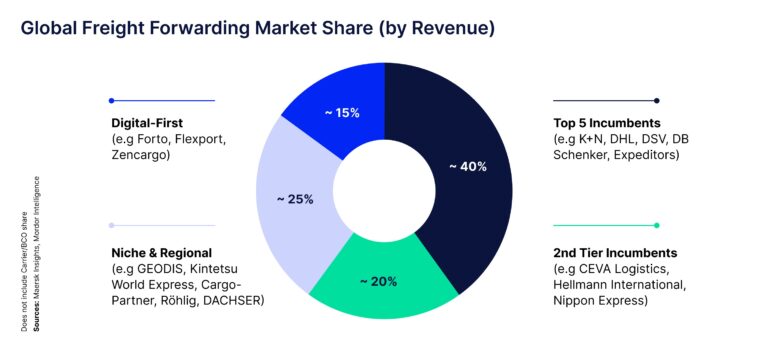
Freight forwarding is a multi-billion-dollar industry with a forecasted annual growth rate (CAGR) of around 5% over the next ten years. Industry analysts estimate the global market at roughly USD 281 billion in 2025. It’s broadly divided into three segments: global incumbents, which account for about 55–60% of total market share; traditional or niche forwarders, around 25%; and digital-first forwarders, 10–15% (see chart below).
Market segmentation overview
Global Incumbents
The top 5 incumbents (DHL Global Forwarding, Kuehne + Nagel, DB Schenker, DSV and Expeditors International) control circa three-quarters of the incumbent segment. Their dominance stems from their vast scale, global reach, and market-leading position. Most have heavily invested in digitization, and now operate hybrid models.
Second-tier Incumbents (such as CEVA Logistics, Hellmann International, and Nippon Express) also have global reach and significant presence but tend to be more specialized than the top 5 players. Many are accelerating their digital investments to close the technology gap with both the top incumbents and newer digital challengers.
Traditional/niche
These players hold about a quarter of the market share. They serve specific industries or specialized services (such as temperature-controlled transport, project logistics, or hazardous goods handling). Primarily regional, with a smaller global footprint, they rely on local expertise rather than technology, though some are gradually adopting digital tools to remain competitive.
Digital-first forwarders
Companies such as Forto, Flexport, and Zencargo belong to the newest and fastest-growing segment of the market. Built around proprietary technology and automation, they leverage advanced tools such as AI, machine learning, and API integrations to deliver flexible, transparent solutions. Their platforms offer real-time visibility, instant quoting, and predictive insights that simplify logistics for shippers. In an increasingly data-driven world, these digital innovators are reshaping the industry, combining technology and expertise to enhance efficiency and customer service.
Market projection
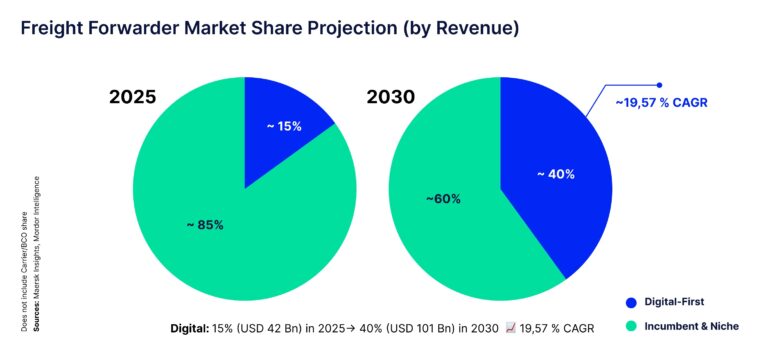
While the overall freight forwarding market is projected to grow, the digital-first segment is expanding much faster, with one report projecting it will reach USD 101.31 billion by 2030 at a CAGR of 19.57%. Much of this growth comes as digital players replace mid-sized traditional forwarders that handle general cargo and lack advanced digital capabilities, rather than large incumbents or specialized niche providers.
This digital-first surge is driven by several global forces: rapid advances in technology such as AI and cloud computing, the continued boom in e-commerce, rising demand for supply chain visibility, faster delivery, and sustainable logistics solutions. As customers expect transparency and real-time tracking, technology-driven forwarders are reshaping how goods move across the world.
Incumbents, Niche & Digital forwarders: How do they compare?
Within the freight forwarding market, each segment offers distinct strengths and capabilities. Understanding these differences will help you identify the type of partner that best aligns with your business goals.
| Aspect | Global Incumbents | Niche Forwarders | Digital-first Forwarders |
| Technology & Automation | Operate as hybrid models, combining traditional networks with selective digital tools such as online platforms and basic AI or analytics, though legacy systems limit full integration. | Limited automation and older IT systems remain common, though some are beginning to adopt partner-based digital tools to improve visibility. | Built around advanced proprietary technology, AI, and API-driven systems to automate workflows, optimize routes, and predict disruptions. Fully digital by design, with modular platforms that enable rapid integration of new technologies. |
| Customer Experience | Provide a reliable but standardized service, with personal attention reserved mainly for large accounts. Scale and complex processes can limit flexibility for smaller customers. | High-touch, personalized service and flexibility with relationships built on local expertise. | Leverage technology to enhance service. Automation and smart workflows free teams to act as strategic partners, providing proactive support and dedicated contact through a seamless digital platform. |
| Operational Expertise | Extensive logistics knowledge and multimodal experience for complex global operations, although legacy systems limit data insights and integration. | Specialized in select industries or trade lanes (e.g., temperature-controlled, project cargo); excel in niche markets. | High efficiency in standardized shipping lanes, supported by data analytics. May have less flexibility for complex or customized logistics solutions. |
| Scalability | Highly scalable through extensive global infrastructure and partnerships; digital tools enhance coordination and efficiency. | Limited scalability due to smaller networks and resource constraints; growth tends to be regional or industry-specific. | Rapidly scalable through modular, asset-light, digital platforms; expansion relies on data and digital integration rather than physical presence. |
| Visibility & Transparency | Provide digital dashboards and tracking, though legacy systems often limit data quality and visibility across regions and modes. | Visibility is often manual or limited, relying on direct communication and personal updates. | Deliver real-time, end-to-end visibility and transparency through superior data and AI-powered insights. |
| Flexibility | Flexibility stems from strong carrier relationships and market influence, allowing access to capacity on short notice, though process agility may be limited by legacy systems. | Highly flexible and responsive to customer needs; excel in tailored, specialized solutions. | Agile and data-driven, adapting quickly through predictive insights and automation. Dedicated customer contacts and AI-enabled workflows ensure flexibility and customized support. |
| Cost Efficiency |
Competitive rates driven by economies of scale, though higher overhead from large networks and staffing can limit pricing flexibility. | Cost-effective for specialized routes or services; pricing can be less predictable due to limited capacity. | Lean cost structures enabled by automation and AI optimization. Often provide faster quoting and transparent pricing, with higher service quality adding further value. |
After reviewing the key aspects and understanding how forwarders differ, the next step is to find the one that best fits your business.
Steps to finding the right freight forwarder
Having examined the key differences, the next step is to decide which forwarder is the right fit. Here’s a simple step-by-step approach to help you choose with confidence.
1. Define your shipping requirements
- Identify your cargo and routes:
– Determine the type of goods you ship, the origin and destination, and the shipment frequency. - List necessary services:
– Decide whether you need additional services, such as warehousing, customs clearance, or cargo insurance. - Assess your technology needs:
– Consider the level of visibility and communication you require (e.g., real-time tracking or automated status updates).
– Check whether an integration with existing systems is needed. - Environmental responsibility:
– If relevant for your business, check whether the forwarder offers greener options, such as CO₂ reporting, route optimization, or biofuels.
2. Evaluate potential forwarders
- Assess experience and reputation:
– Look for a proven track record and good customer reviews.
– Verify accreditations or industry licenses.
– Ask for references. - Check their network and expertise:
– Ensure they have a global network of agents and partners.
– Determine if they have experience with your specific cargo, routes, and industry requirements. - Compare services and technology:
– Confirm they offer the specific services you require, from transportation to customs clearance and sustainability options (CO₂ reporting, biofuels, etc.).
– Evaluate their technology based on the needs you identified in step 1. - Investigate communication and support:
– Ask about their communication methods and how they handle disruptions.
– Inquire about their customer service responsiveness and ability to resolve problems. - Understand pricing and accountability:
– Get detailed quotes to compare costs and ensure transparency.
– Ask about insurance responsibility for your goods. - Regulatory compliance:
– Ensure they comply with international trade regulations and data security standards
3. Test the technology
- Request a platform demo:
– Ask to see how bookings, tracking, and documentation are handled. A forwarder’s digital tools can tell you a lot about efficiency and transparency. - Check system compatibility:
– Confirm whether their platform integrates with your ERP, TMS, or WMS systems. Seamless data exchange saves time and reduces manual errors.
4. Make the final decision
- Meet your shortlisted forwarders:
– Discuss your needs in detail with your candidates and ask for customized proposals that outline services, pricing, and terms. - Run a trial shipment if possible:
– A pilot shipment helps you evaluate reliability, communication, and real-world performance before committing to the long term.
By following these steps, you’ll be able to create your shortlist and identify the forwarders that best align with your shipping priorities and strategy.
Freight forwarder comparison checklist
After you’ve narrowed down your options, use this quick checklist to compare forwarders side-by-side.
| Checklist Item | Why it matters |
| Global reach & network | Ensure your forwarder has a presence and a strong agent/partner network in your origin and destination markets. This matters especially for multi-leg, cross-border shipments. |
| Specialized industry experience | If you transport perishable goods, hazardous material, or oversized cargo, you need a forwarder experienced in this sector to ensure your shipments arrive safely and on time. |
| Technology & visibility | Real-time tracking, automated updates, and digital documentation improve efficiency and transparency, empowering you to make better decisions. |
| Customer support | Responsive, 24/7 support and clear communication help resolve issues fast and keep your shipments moving smoothly. |
| Pricing transparency | Clear, detailed quotes help you compare costs fairly and avoid unexpected fees so you can manage your budget and meet your goals. |
| Performance & reliability track record | Review performance and reliability (e.g. on-time delivery, damage rate, testimonials). Proven expertise helps minimize risk and keep your shipments moving smoothly. |
| Sustainability credentials | CO₂ tracking, greener routing options, and emissions reporting support your company’s environmental goals. |
| Integration capabilities | API or EDI compatibility with your ERP or TMS reduces manual work and streamlines data exchange. |
| Compliance & security | Proper licensing, trade compliance, insurance, and data protection ensure reliability and protect your business from penalties. |
Your ideal forwarder should align with your business goals, leverage the advantages of new technologies, and draw on proven experience. In today’s fast-changing logistics world, agility, flexibility, insight, and responsiveness are what keep your business competitive.
Why Forto could be the right logistics partner for you
As one of the first truly digital freight forwarders, Forto leverages high-quality data, advanced technology, and deep expertise to deliver optimized logistics solutions.
- Easy communication: Access all shipment updates, documents, and messages centrally on our digital platform, Ship by Forto.
- Superior service quality: Our logistics experts, empowered by Flash by Forto (our in-house AI agent), ensure faster responses and seamless operational support.
- Full Visibility: View reliable, real-time shipment insights 24/7 with Ship, powered by superior data and AI driven intelligence.
We continually innovate to deliver smarter logistics solutions that make every shipment faster, more reliable, and more efficient for our customers.
Make Forto your digital logistics partner of choice and ship with confidence.